|
|
 |

Home
: Math Matters - A Brief Look
at How Mathematics has Influenced Modern Life : Nuclear Technology
 |
| Nuclear
Technology |
|
 |
E=mc2
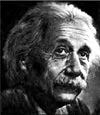
is the world’s most famous equation. Introduced
by Albert Einstein (Swiss,
1879-1955) in 1905, it establishes the
relationship of energy and matter. Einstein,
along with major contributions from his contemporaries
including Bohr, Heisenberg, Rutherford, and
Fermi, dramatically increased science’s
understanding of the nature of atoms and atomic
energy. Einstein, himself, had no direct involvement
with the development of the atomic bomb.
Einstein was also notable for his early adoption
of tensor notation, which offered more efficient
manipulation of multidimensional equations.
The following is a simple example of compact
tensor notation for a vector dot product: |
| |

 |
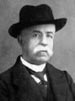
Gregorie-Ricci
Curbastro (Italian, 1853-1925)
invented tensor calculus. Tensor calculus
and tensor algebra are essential tools
in many fields of engineering, including
fluids and solid mechanics, and in modern
physics. All these subjects are critical
to the safe and effective management of
nuclear energy.
|
 |
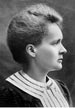
Marie Sklowdowska Curie (Polish,
1867-1934)
discovered the new elements polonium and
radium. Her work deepened our understanding
of radioactive materials, which ultimately
lead to the development of nuclear energy
technology. Curie also pioneered the use
of radiation for cancer treatment. |
|
|
|
|
|