


User Case Study:
Developing Math Modeling Skills of Environmental Studies Students with Maple Flow


Environmental studies programs attract a wide range of students, from those who have a science focus and use math every day, to those with a humanities background who may have done very little math over the last couple of years. This disparity can cause serious challenges for students and their instructors. To address this issue,
He wants his students to understand that when they are working on a quantitative problem, they need to think about more than just the raw calculation. They need to consider units, validate their result to ensure it makes sense, and document everything. He also wants them to learn that sometimes a reasonable estimate is enough to give them the information they need, how to obtain such estimates, and how to improve upon the result when needed. “Maple Flow gives me exactly the environment I need to achieve my goals for this course,” says Alexander. “Not only are the calculations easy to perform, refine, and update, but the built-in units support and paper-like environment enable and encourage students to extend their focus beyond the calculations and really think about what they are doing, what it means, and how to communicate it.”
Communication is Key
Alexander emphasizes to his students that it’s not enough to get to a final number. Communication of the process is extremely important. “I use Maple Flow in this course because I can combine calculations and text in the same document extremely easily, in exactly the way I want them to appear. I tell my students that their goal is to produce a document that can be handed to another person, and that person will immediately understand what the problem is and exactly how it was solved. The Maple Flow environment makes this easy to achieve.”
At the beginning of the course, students sometimes feel that the calculations are too straight-forward to require documentation. But by the end of the course, the students have learned the value of a well-communicated model, especially as they tackle assignments based on earlier work. The better their original Maple Flow document, the easier the new assignment is.
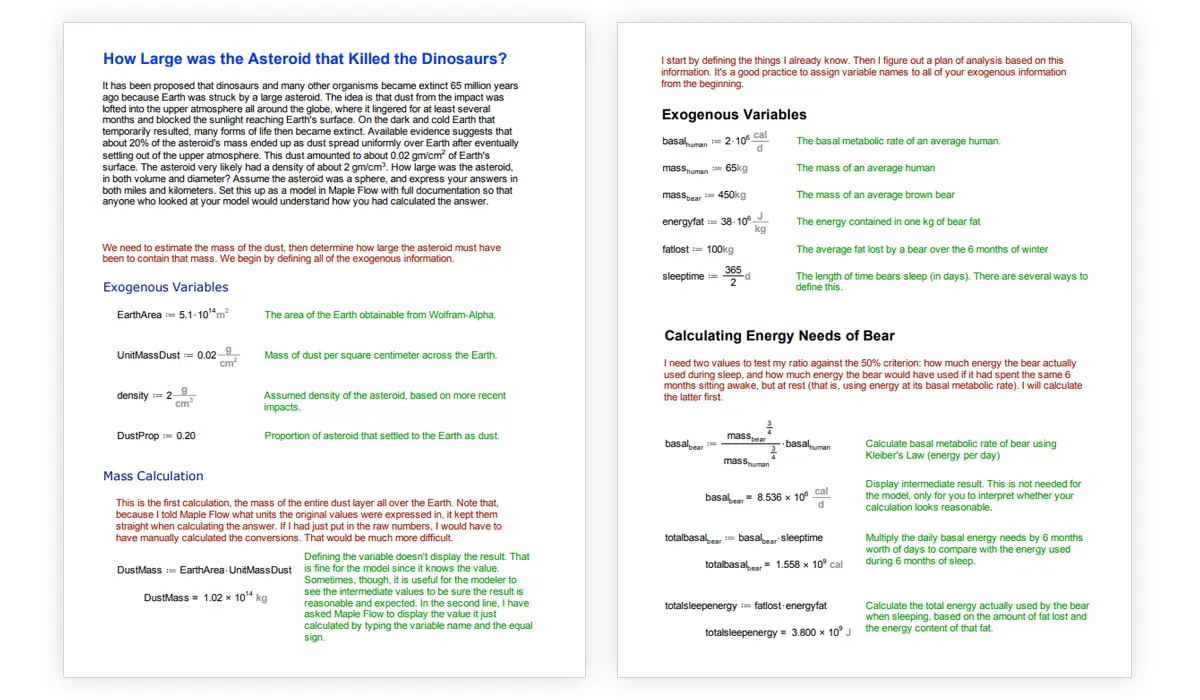
Students use Maple Flow to explore such questions as How Large Was the Asteroid that Killed the Dinosaurs?1 and Are Bears True Hibernators?2 in order to develop quantitative modeling skills.
I believe Maple Flow adds a lot of value, not just for engineering, but for programs like environmental studies, psychology, sociology, and economics.”
Affordability
Alexander used to use an old version of Mathcad® in this course, but eventually it stopped working on more recent operating systems. “My school simply could not afford a license for the current version of Mathcad. Maplesoft offered much more flexible pricing that better suited our needs.”
Alexander is excited about the possibilities of using a product like Maple Flow in other fields that use calculations. “I believe Maple Flow adds a lot of value, not just for engineering, but for programs like environmental studies, psychology, sociology, and economics.”
1 Problem from Harte, John. Consider a Spherical Cow: A Course in Environmental Problem Solving. University Science Books. 1988. ISBN: 0-935702-58-x
2 Problem from Harte John. Consider a Cylindrical Cow: More Adventures in Environmental Problem Solving. University Science Books. 2001. ISBN: 1-891389-17-3
 Contact Maplesoft to learn how Maple Flow can help with your projects
