
 |
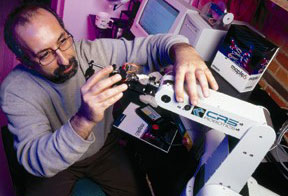


Quanser Consulting (Toronto, Canada) is used to facing tough technological challenges. With clients ranging from NASA and the National Science and Research Council of Canada to leading universities around the globe, Quanser is the world's leader in the design and manufacture of advanced systems for real-time control design and implementation used in education, research, and industrial applications.
In the industrial sector, Quanser's success has been enhanced by its work with CRS Robotics Corporation (CRS) (Burlington, Canada) in developing the world's first commercially available open-architecture industrial robot.
"Developing the inverse kinematic solutions for five degree of freedom (5DOF) and six degree of freedom (6DOF) robots could take an individual several weeks to do by hand-and even then there might be doubt as to whether the result is right," says Dr. Jacob Apkarian, president of Quanser (in photo above). "With Maple, we can develop the equations, test them, and verify them in about three hours."
That kind of productivity improvement has been an essential part of Quanser's ongoing success.
According to Dr. Apkarian, Maple is essential for the successful acceleration and completion of the design cycle.
"In our business, we always develop differential equations for dynamical systems, and many of these equations are difficult-if not impossible-to solve by hand," he says. "So we tried Maple to see if its symbolic tool would help us to solve these equations, or to verify equations for our existing systems, in a simple way."
That initial tryout was 10 years ago-and Quanser has been using Maple ever since.
The current release, Maple 6, is the most powerful and technologically advanced computation system of its kind. With world-renowned symbolic algorithms and industry-leading numeric solvers, the application is an invaluable time- and labor-saving tool for solving tough computational problems.
"Without developing differential equations, it would be very difficult to design a control systems for the systems we build," says Apkarian. "In order to build working control systems, we need to develop the equations of motion as systems of nonlinear differential equations," says Apkarian, "Without developing differential equations, it would be very difficult to design control systems for the systems we build."
He adds, "But we don't just use Maple for differential equations. As in the development of the CRS robots, we use it for critical forward and inverse kinematic equations."
Such equations are used to determine the position of the end effector, i.e. the tip of the robot arm equipped with a tool, given the joint angles of the robot; or more importantly determining the joint angles given the desired position of the end effector.
The results of such computational power in Quanser's recent collaboration with CRS are the world's first commercially available open-architecture 5DOF and 6DOF industrial robots.
Opening Up New Worlds of Robotic Control
The CRS A255 and A465 articulated arms are proven industrial robots with over 2000 installations worldwide, in applications ranging from automated laboratory tasks and automotive assembly to repetitive product testing-setting the standard in "human scale" automation. The C500C controller and RAPL3 programming language for task planning and coordination support the robots. The fixed-architecture controller assures proper operation while preventing implementation of other dynamics and kinematics feedback controllers.
"We've developed a turnkey method of switching seamlessly from the C500C controller to a fully open-architecture controller," says Apkarian. "The Quanser solution uses its WinCon real-time control software and MultiQ data acquisition board to provide the user with remarkable control flexibility."
"Now, those using the CRS Robots can design any control strategy they wish, by using Simulink®" and running it in real time with WinCon and MultiQ on a PC." continues Apkarian.
Users can also write their own C programs to control the robot. CRS robots are used to automate a wide range of tasks that require the flexibility, speed, and lifting capacity of the human arm-machine loading and other material-handling tasks, dispensing, assembly, packaging, palletizing, product testing, and processing tasks such as drilling, grinding, and cutting.
"Opening up the architecture will speed and simplify the implementation of robotics to meet these needs," Apkarian says.
This is how Quanser adds value to robotics-converting robots from closed to open architectures, and providing open source code that easily extends the functionality of applications.
Broad Utilization, Strong Benefits
According to Apkarian, Maple is a valuable tool throughout his operations. Quanser is involved in much more than robotics per se. The company currently markets over 35 other advanced mechatronic systems.
"Maple is an exceptional tool not only for solving equations, but for gaining insight into the behavior of complex dynamical systems," he says. "For example, we're designing controls for flexible structures that simulate tall buildings. We've used Maple to develop differential equations for the structures and to develop controllers that would dampen vibrations and their effects under earthquake conditions."
Quanser is also using Maple to develop Internet applications.
"We've developed controls for a three degree of freedom helicopter that can be flown via the Web, and are developing a six degree of freedom helicopter model and spacecraft simulation-all using Maple," he says.
When Quanser chose Maple a decade ago, it was, in Apkarian's view, the best computational system available. The product has performed so well and so consistently over that time that Quanser has never considered another.
"We use it for our controllers, for forward and inverse kinematics, and for nonlinear dynamic equations," Apkarian says. "And it has much more power than what we're using it for-we're only using it to model electromechanical systems; there are other applications we haven't even tapped yet".
What Quanser has tapped into is Maple's tremendous ability to free designers from the cumbersome and tedious mathematical manipulations and concentrate on their creativity and innovation. This freedom automatically translates to cost reductions and fast product development in a highly competitive arena
"Clearly, it has saved us a lot of time and money in developing control systems that work-quickly," says Apkarian. "I would say that Maple speeds development on the order of 10x to 100x or more. The fact is, I can't imagine running our operations without Maple. It's really a tremendous tool for engineering."
Jacob Apkarian graduated with a B.Eng. from McGill University and an M.A.Sc. and Ph.D. from the University of Toronto. Before starting Quanser Consulting Inc. in 1989 he held the positions of assistant professor at the University of British Columbia, Robotics and Assistive Devices Director at Lyndhurst Hospital and Senior Engineer at Spar Aerospace.
Simulink is a registered trademark of The MathWorks, Inc.
 Contact Maplesoft to learn how Maple can be used for your projects
|
 |
|
© Maplesoft, a division of Waterloo Maple
Inc. 2016. | Terms of Use | Privacy | Trademarks MATLAB, Simulink, and Simulink Coder are trademarks or registered trademarks of The MathWorks, Inc. |
|


